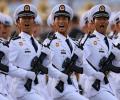
China's latest defence budget surges to $275 billion, fueling its ambitious military modernisation program and intensifying geopolitical dynamics in the region.
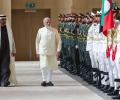
Prime Minister Narendra Modi has offered India's support to bring peace to West Asia during talks with UAE President Sheikh Mohamed bin Zayed Al Nahyan. Both countries signed agreements to strengthen strategic collaborations in energy and defence.

External Affairs Minister S Jaishankar conveyed a strong message to his Polish counterpart Radoslaw Sikorski regarding terrorism and the Ukraine conflict, emphasizing the need for zero-tolerance towards terrorism and criticizing the selective targeting of India.

Recent BJP organisational moves and Rajya Sabha nominations have sparked speculation that Prime Minister Narendra Modi may soon undertake a ministerial reshuffle.

The NEET-UG re-exam was held at centres across the country and overseas on Sunday amid tight security arrangements for the smooth conduct of the examination.

Prime Minister Narendra Modi and US Secretary of State Marco Rubio discussed various aspects of India-US bilateral ties, focusing on defence, trade, energy, and technology. Rubio extended an invitation from President Donald Trump for PM Modi to visit the US.

The boundary mess between India and Nepal needs a solution in a manner as mentioned by Nepal's Foreign Minister Shishir Khanal: 'On evidence not emotions', counsels Lieutenant General Shakti Gurung (retd).

To get its act going in Myanmar, India would need very dynamic diplomacy and not the lazy all-eggs-in-one-basket approach, points out Subir Bhaumik.

Prime Minister Narendra Modi will visit the UAE, the Netherlands, Sweden, Norway and Italy to deepen India's bilateral ties amid geopolitical changes.

Over the years, India-EU ties have grown, and covered trade, investment, climate change, science and technology, space, digital, mobility, and connectivity.

India has firmly denied allegations that the US Navy is using its ports to launch attacks against Iran, reaffirming its commitment to strategic autonomy and non-alignment in international conflicts.

The Indian embassy in Tehran has earlier stated that it is facilitating the safe movement of nationals who wish to leave Iran.

For the foreseeable future, the most likely outcome remains continuation of the status quo. Taiwan will remain self-governing without formally declaring independence, while China continues to apply sustained pressure short of war, predict Krishnan Srinivasan and Manoj Mohanka.

Prime Minister Narendra Modi has begun a six-day tour of the UAE, the Netherlands, Sweden, Norway and Italy to strengthen bilateral relations amid geopolitical challenges. The trip will focus on energy security, trade, and technological cooperation.

Work has commenced on restoring the North and South Blocks to their original design, paving the way for the Yuge Yugeen Bharat National Museum project, with a target completion date for the first phase set for 2028.

Ukraine has lodged a formal protest with India regarding the detention of six Ukrainian nationals in Mizoram, alleging unauthorised entry and unlawful activities. The Ukrainian Foreign Ministry is seeking consular access and immediate release of its citizens.

Under the defence partnership, India and the UAE are eyeing defence industrial collaboration and cooperation in advanced technologies, cyberspace training, special operations, interoperability of their militaries and counter terrorism.

Union ministers paid tribute to the victims of the Pahalgam terror attack on its first anniversary, reaffirming India's commitment to combating terrorism with a firm and zero-tolerance policy.

The Cabinet Committee on Security (CCS) has reviewed the evolving situation in West Asia, directing departments to assist Indian nationals affected by recent developments and emphasizing the need for dialogue and diplomacy.

Russia's First Deputy Prime Minister Denis Manturov met with Indian leaders to discuss strengthening bilateral ties in key sectors amidst the escalating conflict in West Asia.
India has categorically rejected allegations of its involvement in transnational violence or organised crime in Canada, following a media report linking Indian officials to the killing of Sikh extremist Hardeep Singh Nijjar.

India has strongly denied Pakistan's accusations of its involvement in the suicide bombing at a mosque in Islamabad, calling the allegations baseless and a deflection from Pakistan's internal issues.

Prime Minister Narendra Modi convened a meeting with senior ministers to assess the impact of the evolving situation in West Asia on India's crude oil, gas, petroleum, power, and fertiliser sectors, focusing on ensuring uninterrupted supply and stable logistics.

US President Donald Trump's call to Prime Minister Narendra Modi signals a concerted effort to reset strained Washington-New Delhi ties, with a focus on 'big-ticket' energy and trade deals, including increased Indian imports of US LNG and LPG, and potential cooperation on small modular reactors.

The Ministry of External Affairs (MEA) reports that over 1,150 Indian nationals have been evacuated from Iran through land borders into Armenia and Azerbaijan since the start of the West Asia conflict. The MEA also confirmed that three Indians were injured in attacks in the UAE.

The Indian government addressed opposition concerns regarding the West Asia crisis in an all-party meeting, outlining its strategy for ensuring the security of the Indian diaspora, fulfilling energy needs, and maintaining diplomatic relations with key partners. The government also dismissed Pakistan's reported mediation efforts.

There is no cause for concern, as the overall situation arising out of the crisis is firmly under control, the Centre informed while briefing political parties at the all-party meet.
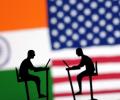
David Perdue said in a post on X that the US-India relationship delivers real results through close cooperation in diverse areas, including defence, energy and through Quad engagement.

'India should understand that we are not going to make the same mistakes with India that we made with China 20 years ago.'
India and Belgium on Monday explored potential defence engagements in the Indo-Pacific, particularly in the maritime domain, and discussed ways to strengthen defence industrial cooperation.

In a region increasingly shaped by competition and coercion, such collaboration strengthens security without confrontation, builds capacity without dependency and promotes order without domination, points out Dr Kumar.

The Dhurandhar movies will undoubtedly shape the minds of the audience much more than news reports, court investigations, books and documentaries. But it is worth remembering that Pakistan's irridentist claims against India's national security have succeeded due to strategic planning, diplomacy, and the unsung heroines and heroes across government agencies, not due to a single maverick leader, points out Shweta Desai.But it is worth to remember that Pakistan's irredentist claims against India's national security have succeeded due to strategic planning, diplomacy, and the unsung heroines and heroes across government agencies -- not a single maverick, points out Shweta Desai.

Iran was the chance to arrange a concert of nations, to actually be a Vishwaguru. Instead, we are watching from the sidelines as Pakistan, the same country that is apparently still at war with Afghanistan, hosts talks between US-Israel and Iran. The irony is hard to miss, points out Amberish K Diwanji.

Since June, India's ministry of external affairs has intensified its diplomatic calendar, hosting several heads of state and government, foreign ministers, and key trade delegations.

A 22-year-old man from Gujarat's Morbi town, captured by Ukrainian forces while fighting for the Russian military, has sent a video message to his family here, making an emotional appeal for help from the Indian government for his release.

'We are considering this to ensure swift action on content for which the respective ministries have domain experts and can better determine the illegality of the content or the web site that needs to be taken down.'

Prime Minister Narendra Modi is scheduled to visit Israel for two days to discuss bilateral and regional issues, marking his second visit to the Jewish state and highlighting the growing strategic partnership between India and Israel.

Iran is fighting a different war: Older, slower, and in some ways more dangerous. Iran doesn't need to shoot down an F/A-18. It only needs to make the Strait of Hormuz feel dangerous long enough for insurance markets, shipping companies, and oil futures traders to do the rest. Prem Panicker continues his must-read daily blog on the war in the Middle East.

India observed the first anniversary of the Pahalgam terror attack, with leaders paying homage to the victims and asserting the country's commitment to fighting terrorism.

'I suspect that Bangladesh being given permission stuck in India's official craw, and this story was an attempt to balance the scales by giving the impression that a similar waiver had been given to India as well.'
